| Ceramic GyroTM |
|
 |
Piezoelectric gyroscopes are
sensors which use piezoelectric oscillators to capture the
rotational movements of objects, and are essential for compensating
for hand shaking in video and digital still cameras.
The
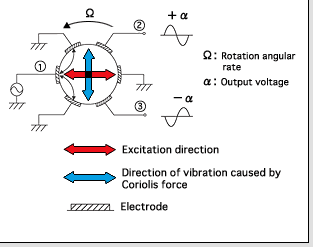
principle of piezoelectric gyroscopes is the same as that of the
Foucault pendulum. A piezoelectric element vibrates a rod, which
causes it to work as a pendulum. Then, the Coriolis force that
occurs when movement is applied is extracted after it is converted
into voltage by the piezoelectric
element. |
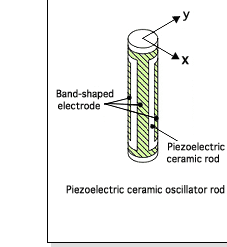
A feature of the NEC TOKIN
Ceramic gyro is that the vibrating element is made up of a
cylindrical piezoelectric ceramic oscillator rod. On this rod, six
electrodes are printed and polarized. This structure is as effective
as that of a rod carrying three piezoelectric elements. When voltage
is applied to the piezoelectric ceramic oscillator rod, it
torsionally vibrates. When the rod rotates, it outputs voltages in
proportion to the rotational velocity.
The greatest advantage of
the structure of the oscillator--a cylindrical ceramic rod--is that
it can easily be processed with high accuracy. When conventional
square-shape rods were used, it was difficult to accurately make the
thickness and horizontal width, as well as the lengthwise and
crosswise proportions uniform. On the other hand, high accuracy can
be achieved with rods because they can be processed while they are
rolled; therefore they are highly effective in downsizing elements
with high performance.
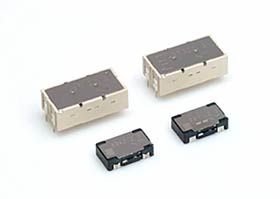
In fact, the CG-L53, our flagship
gyroscope, employs a downsized ceramic rod with a thickness of 0.8
mm and a length of 9 mm. Since Ceramic gyro are highly sensitive to
movement, they can detect a wide range of movement from low-speed
rotation (0.1° per sec.) to high-speed rotation (1500° per
sec.). |
 |
The NEC TOKIN Ceramic gyro has
so far been widely used as sensor devices for stabilizing the images
of video cameras. However, the downsizing of the gyro has opened the
way to new applications--one of which is the application of the gyro
to digital still cameras.
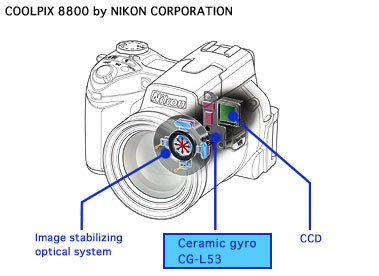
Digital still cameras are one of the
new three sacred treasures of digital consumer electronics. Many
people are interested in them. Recently, image stabilizing systems
are being highlighted in them. Since compact and stylish bodies are
required for them, downsized piezoelectric gyroscopes that take up
little space are indispensable to realizing an added value, image
stabilization.
Image stabilizing systems will continuously be
highlighted. In the foreseeable future, Camera module for cellular
phones will have an image stabilizing system.
Since our Ceramic
gyro contributes to the downsizing of products, we will provide it
for the image stabilizing systems of various camera
devices. |
 |
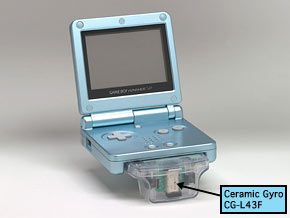
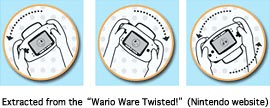
In addition, Ceramic gyro are
being employed in game software cartridges; this is a brand-new
application.
Nintendo provides game software, "Wario Ware
Twisted!", for Game Boy Advance. Unlike other conventional games,
this game software enables the user to enjoy various mini games
while the game machine is held and rotated right and left. This is
an unprecedented game system and highly esteemed in the game
industry. The game itself is sensorial and enjoyable.
The sensor
of "Wario Ware Twisted!" employs our Ceramic gyro. The downsized and
high-performance gyro is a key device for realizing this enjoyable
game. In sum, it can be said that our Ceramic gyro has opened a new
possibility in the field of games.
Our Ceramic gyro is also
used for 3D motion sensors. Since 3D motion sensors contain
three Ceramic gyros, the use of our latest miniature gyros has
drastically downsized the capacity of the sensors from 30 cc to 6
cc.
This means that the 3D motion sensors containing the
miniature gyros can easily be used for robots and virtual reality
systems.
Furthermore,Ceramic gyros are used for the attitude
control systems of radio-controlled cars and helicopters.
Our
Ceramic gyro, downsized and high-performance gyroscopes, will be
used in various fields in the future. |
|